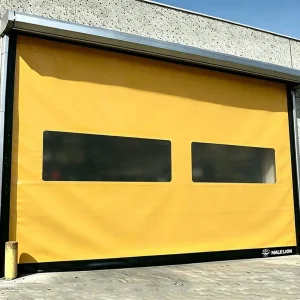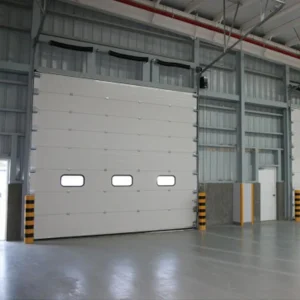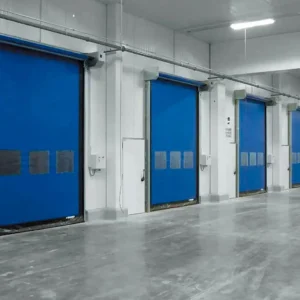
Industrial facilities depend on the doors that guard their loading bays, production halls, and perimeter openings. These doors do far more than open and close — they manage traffic flow, seal in conditioned air, resist weather, and operate thousands of times a year without failing.
Two categories dominate today’s market: spiral high-speed doors (often sold as high speed spiral door systems) and traditional rolling shutters. Both roll up, and both occupy similar wall space. But their engineering, operating speeds, and total cost of operation are fundamentally different. Choosing the wrong one can quietly drain energy budgets, slow down logistics, and inflate maintenance costs.
This article explains how each type works, where they differ, and what those differences mean for a real facility — before introducing the specific capabilities of a modern rigid high-speed insulated door.
How a Traditional Rolling Shutter Works
A conventional rolling shutter is a curtain of interlocking slats that coils around a barrel above the opening. The slats travel inside vertical guide channels and physically contact one another as they wind and unwind. The drive is usually a standard geared motor, often with a chain or a simple limit-switch control.
This is a mature, inexpensive technology. These industrial roller doors are widely used for shop fronts, storage rooms, and low-traffic security barriers. For those applications, it works well. The limitations appear when a rolling shutter is asked to do more.
The key constraints are speed, energy, and duty. Traditional shutters open slowly, typically well below one metre per second, because the curtain and motor are not built for rapid acceleration. They also wear from the very motion that makes them function: slats rub against each other and against the guides on every cycle, producing friction, surface scratching, and noise. Over time, this friction generates maintenance work and shortens component life.
For an industrial loading bay that cycles a door hundreds of times per shift, these characteristics translate directly into slower turnaround, heat loss, and higher upkeep.
How a Spiral High-Speed Door Works
A spiral high-speed door takes a different physical approach. Instead of stacking slats so they touch, it guides the curtain along a non-contact spiral track. The slats are carried into a circular coil where no panel ever touches its neighbour. Because there is no slat-to-slat contact, there is no surface wear from coiling and almost no operating noise.
This single design choice changes everything downstream. Without friction, the door can travel far faster — typically up to around 1.0 m/s — and can sustain very high duty cycles. It also allows the door to be driven by a modern servo motor with digital control, which brings precise position memory, smooth acceleration, and soft terminal buffering.
The result is a door category built for high-traffic industrial portals: automotive plants, food processing facilities, logistics hubs, and anywhere a door must open and close frequently, quickly, and reliably.
The Core Differences at a Glance
| Comparison | Traditional Rolling Shutters | Spiral High-Speed Doors |
| Operating Speed | Generally operate at slower speeds, making them more suitable for low-frequency use. | Adjustable opening and closing speeds of up to approximately 1.0 m/s. |
| Wear and Service Life | Slats rub against each other and the guide channels, causing friction, noise, and surface wear. | Non-contact spiral tracks prevent panel-to-panel friction, reducing noise and mechanical wear. |
| Thermal Performance | Basic models provide limited thermal insulation. | Insulated door panels help maintain indoor temperatures and reduce heat exchange. |
| Wind Resistance | Lightweight shutter curtains may have limited resistance to strong wind pressure. | Rigid interlocking panels and heavy-duty guide channels provide stronger wind resistance. |
| Control System | Typically use standard motors and basic limit-switch controls. | Servo drive systems with digital processors and absolute encoders enable precise positioning and soft buffering. |
| Safety Features | Safety configurations vary depending on the model and application. | Can integrate photocells, wireless safety bottom edges, and optional full-height light curtains. |
| Maintenance | Panel friction and impact damage may increase maintenance requirements. | Modular panel construction allows individual damaged panels to be replaced without dismantling the entire door. |
| Typical Applications | Shop fronts, storage rooms, and low-frequency security openings. | Warehouses, logistics centers, manufacturing facilities, and other high-traffic industrial openings. |
When comparing different types of roller doors, it is important to consider the differences in operating speed, wear, insulation, weather resistance, and control.
Neither option is universally better. Traditional rolling shutters remain a practical and economical choice for openings with relatively low operating frequency and basic security requirements. Spiral high-speed doors are better suited to facilities that require frequent operation, faster traffic flow, improved thermal insulation, and reduced mechanical wear.
The right choice ultimately depends on the opening’s operating frequency, environmental conditions, and long-term maintenance requirements.
Choosing Between the Two
The decision should follow the demands of the opening rather than the price tag alone. Several questions point toward the right answer.
First, consider duty cycle. How many times per shift does the door open and close? A shutter suits an opening cycled a handful of times a day; a high-speed spiral door earns its cost on a bay that cycles constantly.
Second, consider what the door is protecting. If the opening separates a heated or cooled space from the outdoors, insulation and sealing speed become direct energy costs. A fast-closing, insulated door shrinks the window of air exchange.
Third, consider wind exposure. Exterior bays on tall or exposed buildings face real wind loads. A door that must hold its integrity in strong wind needs rigid construction, not a light curtain.
Fourth, consider maintenance and downtime. In continuous operation, a door that wears from friction will demand attention sooner. A non-contact design and modular replacement both reduce that burden.
Finally, consider safety. A rapidly moving industrial door must not become a hazard. Photocells, safety edges, and optional light curtains are not accessories here — they are part of the operating standard.
A Reference Implementation: The Spiral Rigid High-Speed Insulated Door
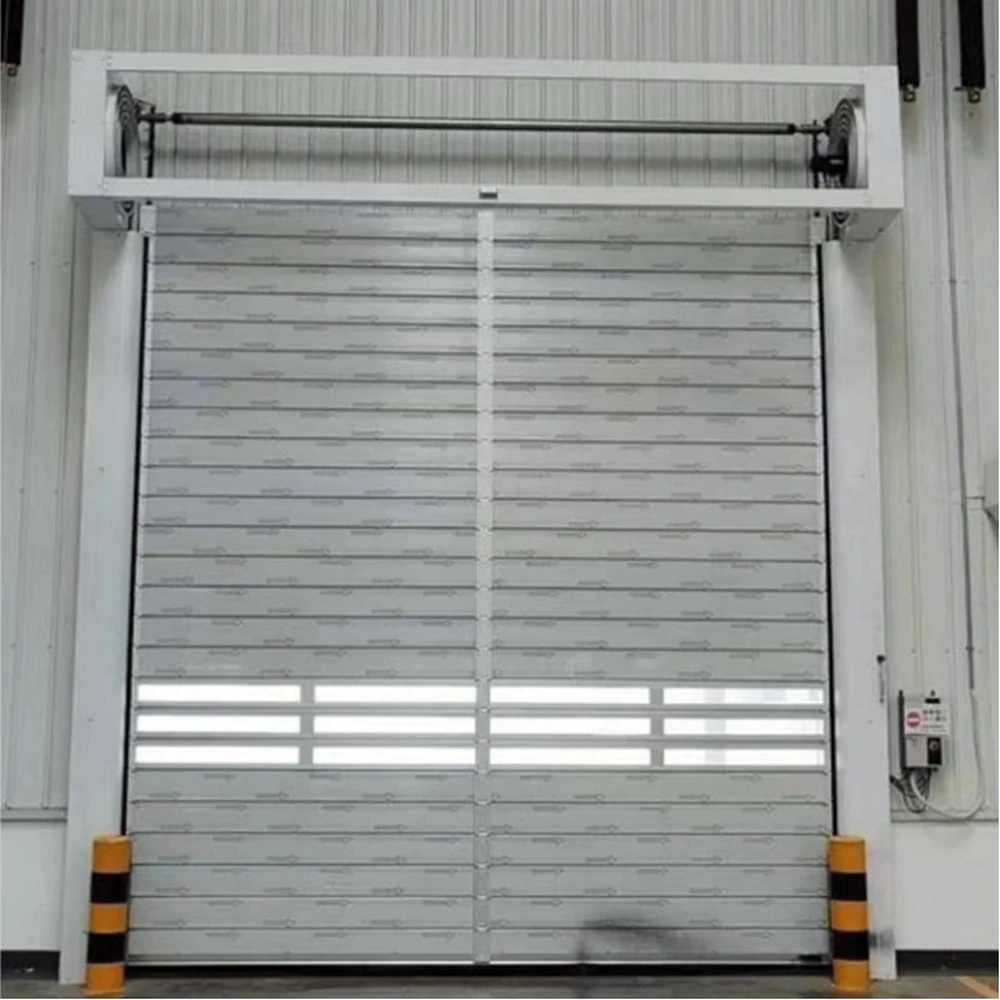
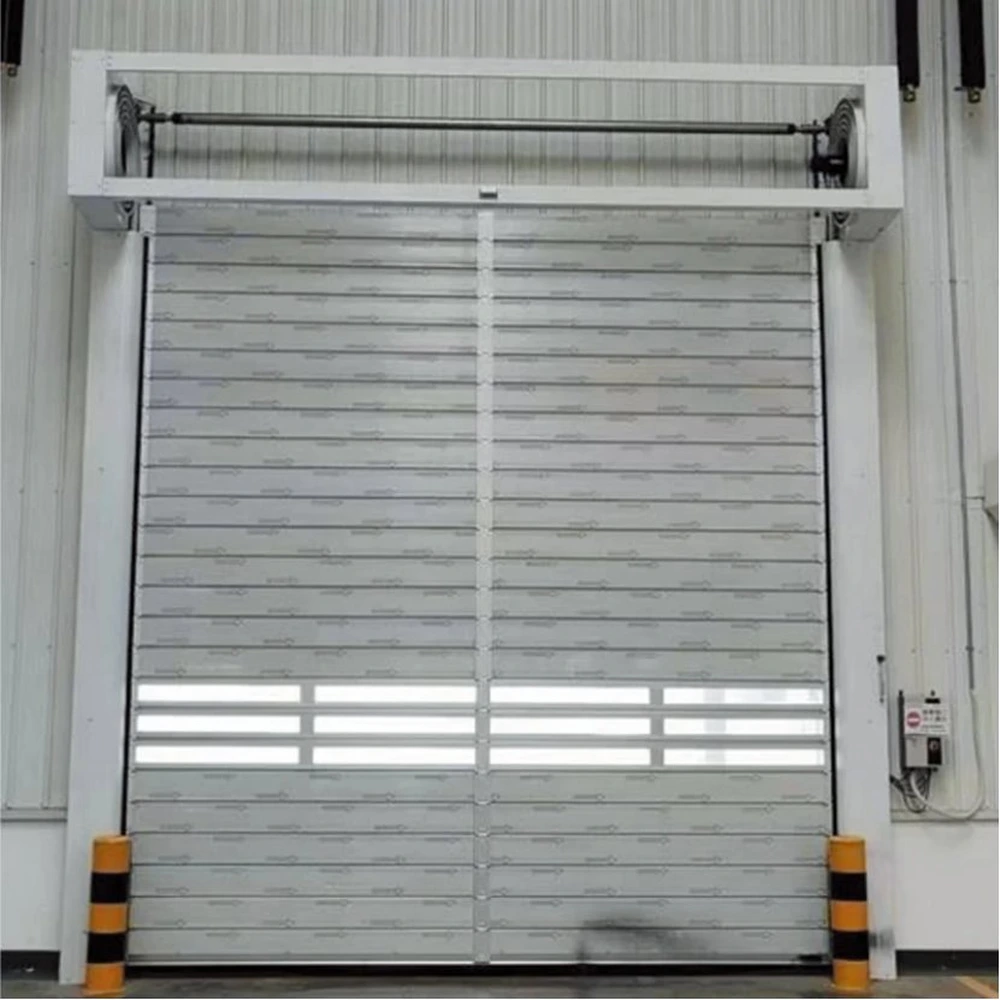
With the principles above in mind, a concrete example shows how these ideas come together in a production door. Designed for demanding industrial environments, MaleLion’s spiral rigid high-speed door is one of the industrial high speed doors solutions available for facilities that require fast access, reliable operation, and effective thermal insulation.
1. Insulated Aluminum Panel Construction
Its construction starts with 45 mm thick thermal-break aluminum slats. Each panel is built from dual 0.7 mm aluminum skins with an integrated thermal break profile and an injected high-density polyurethane foam core at 45 kg/m³.
This yields a thermal transmittance of K≤0.6 W/(m²·K) on a closed 4 m × 3 m door — a figure that directly supports energy efficiency in temperature-controlled environments — while also providing structural rigidity and impact resistance.
2. Non-Contact Spiral Track and High-Speed Operation
The curtain rides a non-contact spiral guide track with a dual-turbine geometry. Slats are carried into a circular coil where panels never touch one another, eliminating surface scratching and mechanical friction.
This is what allows quiet, vibration-free travel at speeds up to 1.0 m/s and sustained duty over 150,000 operating cycles per year.
3. Wind Resistance and Drive System
For weather exposure, the rigid interlocking panel structure and heavy-duty 2.3 mm galvanized guide channels are rated to withstand wind loads up to Grade 12 (120 km/h), covering strong positive and negative pressure conditions.
Drive and control come from an advanced servo direct-drive system paired with a high-speed DSP processor and a multi-turn absolute value encoder. The system holds continuous torque, remembers its position across power outages, and applies digital soft-cushion terminal buffering to protect the gear reducers from mechanical shock.
Hinge connections use QPQ-treated steel pins with low-friction PEEK bushings for wear resistance, self-lubrication, and corrosion protection in washdown or chemical environments.
4. Maintenance and Emergency Operation
Two further details matter for operators. An integrated counterbalance of dual torsion and tension spring assemblies inside the side columns reduces motor strain, while a manual brake release lever allows the door to be opened manually during a power failure.
And because damage is sometimes unavoidable, independent slat modular replacement lets a single technician swap out a damaged panel without dismantling the entire door leaf.
5. Safety Features and Track Configurations
Safety is engineered in accordance with DIN EN 12604. Standard equipment includes dual-height photocells at 450 mm above floor level and a wireless safety bottom edge, with an optional 1800 mm high-density optical light curtain, magnetic floor loops, and Bluetooth or RFID proximity sensors for activation.
To fit different overhead conditions, the door offers three track architectures:
- Circular spiral track: For facilities with normal headroom.
- Oval spiral track: For openings with restricted overhead clearance.
- Low-headroom track: For underground parking garages and low-ceiling loading bays.
Slats are available as PU-foamed insulated panels, lightweight aluminum hollow slats for interior partitions, or fully transparent polycarbonate vision slats. Finishes include anodized aluminum, champagne gold, signal blue, pure white, or custom RAL colours.
6. Power Specifications and Typical Applications
The power supply is single-phase 220 V / 14 A / 50 Hz, the motor is an industrial servo coaxial unit with IP54/IP65 protection, and the control cabinet is a heavy-duty IP54 unit with an LED fault display.
Typical applications follow directly from these capabilities:
- Automotive manufacturing and logistics: High-frequency body-shop portals and exterior shipping bays.
- Pharmaceutical and food processing: Facilities requiring thermal separation, dust prevention, and washdown resistance.
- Chemical and heavy industrial plants: Environments with corrosive conditions or high wind exposure.
- Underground parking and commercial garages: Vehicle entrances requiring low-headroom designs, quiet operation, and high-duty performance.
Conclusion
Choosing between spiral high-speed doors and traditional rolling shutters depends on the operating demands of the facility. Traditional rolling shutters remain a cost-effective option for openings with low traffic frequency and basic security needs. However, for industrial sites that require faster access, better thermal insulation, stronger wind resistance, and more frequent operation, spiral high-speed doors offer clear practical advantages.
The MaleLion Spiral Rigid High-Speed Insulated Door combines a non-contact spiral track, insulated aluminum panels, a servo drive system, and modular maintenance features to support demanding industrial environments. Its different track configurations and panel options also make it adaptable to various building layouts and application requirements.
If you are planning to upgrade an industrial entrance or select a door for a new facility, contact the MaleLion team to discuss your opening dimensions, operating conditions, and configuration requirements. We can help you identify a suitable spiral rigid high-speed door solution for your project.
FAQs
1. What is the main difference between a spiral high-speed door and a traditional rolling shutter?
The main difference is the curtain movement structure. Traditional rolling shutters use interlocking slats that contact each other as they roll up, while spiral high-speed doors guide panels through a non-contact spiral track to reduce friction, noise, and surface wear.
2. Are spiral high-speed doors suitable for exterior industrial openings?
Yes. Rigid spiral high-speed doors with insulated panels and reinforced guide channels can be used for exterior industrial openings. The required wind resistance, insulation, and safety configuration should be selected according to the site’s conditions.
3. How do I choose the right spiral high-speed door for my facility?
Consider the opening dimensions, operating frequency, available overhead space, insulation requirements, wind exposure, and safety needs. These factors will help determine the appropriate door panel, track configuration, and control system.