Why Does Choosing the Right Industrial Door Matter?
Industrial doors are an important part of warehouse, logistics, and manufacturing facilities. They provide access for vehicles and personnel while helping separate indoor work areas from the outside environment. The right door can also support temperature control, improve daily traffic flow, and meet the practical requirements of different working environments.
However, not every industrial door is suitable for every facility. A warehouse with frequent forklift movements may need a different configuration from a food processing facility that requires better thermal insulation. Similarly, a manufacturing plant with large equipment may need a wider and taller opening than a commercial workshop.
When evaluating industrial overhead doors, buyers should consider the opening dimensions, insulation requirements, operating frequency, access methods, and environmental conditions. Understanding these factors makes it easier to select a door that fits the facility’s operations rather than focusing on a single specification.
1. Determine the Required Door Dimensions
The first step is to establish the clear opening width and height. These dimensions should accommodate the vehicles, equipment, and goods that regularly pass through the doorway.
For warehouses and logistics centers, loading operations often involve forklifts, palletized goods, and delivery vehicles. An opening that is too small can restrict movement and make daily handling less convenient. Manufacturing facilities may also require sufficient clearance for large components or equipment.
Buyers should consider the largest items that need to pass through the opening, along with the clearance required for safe movement. The available installation space should also be checked when planning the door configuration.
For facilities with large access requirements, sectional overhead doors offer a practical arrangement because their panels move upward and follow the designated overhead track system. The final configuration should match both the required clear opening and the building’s installation conditions.
2. Choose the Right Insulation Level
Thermal insulation is an important consideration when a doorway connects an indoor working area with the outside environment. Heat can escape during cold weather, while external heat can increase indoor cooling requirements in warmer conditions.
The appropriate insulation level depends on the facility’s operating environment. A general warehouse may have different requirements from a temperature-sensitive production area or a cold-chain facility.
When comparing industrial sectional doors, buyers should review the panel construction, insulation material, panel thickness, and available thermal performance data. The U-value is particularly useful because it measures thermal transmittance. A lower U-value indicates less heat transfer through the tested door assembly under comparable conditions.
Panel thickness alone does not establish the complete thermal performance of a door. Buyers should also check the sealing arrangement and confirm the conditions under which the published U-value was measured.
Selecting insulation based on actual operating requirements helps balance thermal performance with the facility’s other access and operational needs.
3. Evaluate Weather Resistance and Air Tightness
Industrial doorways can be exposed to wind, rain, and changing outdoor temperatures. The level of protection required depends on the building location, door dimensions, installation conditions, and intended application.
For exterior openings, wind load resistance is an important factor. A door must be selected according to the applicable performance rating and the requirements of the installation. Wider openings and configurations with integrated pedestrian doors may have different performance ratings from smaller, solid-panel configurations.
Water permeability and air permeability are also worth reviewing. Water permeability indicates how a door performs against water penetration under the relevant test conditions, while air permeability concerns the passage of air through the door assembly.
When comparing sectional overhead doors, buyers should look for test results linked to recognized standards rather than relying on general descriptions such as weather-resistant or airtight. It is also important to confirm whether the stated ratings apply to the proposed door size and configuration.
4. Consider Operating Methods and Daily Traffic
The way a door opens and closes can affect the movement of people, vehicles, and goods throughout a facility.
In busy warehouses, loading areas, and production plants, the operating method should suit the traffic pattern. Wall-mounted pushbuttons provide a straightforward control option, while remote controls, pull cord switches, magnetic floor loops, and microwave radar sensors can support different operating requirements.
Safety devices also deserve attention. Cable-break protection, spring-break protection, bottom safety edges, and in-track photocells serve different safety functions. Buyers should confirm which devices are included in the selected configuration and whether additional controls are needed for the intended operating environment.
Power interruptions are another practical consideration. Where continued access is important, the availability of a manual emergency operating method can help personnel operate the door when electrical power is unavailable.
The choice of drive system should be based on the door’s dimensions, weight, and operating requirements rather than motor power alone.
5. Decide Whether a Pedestrian Door or Vision Panels Are Needed
Not every movement through an industrial doorway requires the full opening. In facilities where personnel frequently enter and leave while vehicle traffic is limited or intermittent, an integrated pedestrian wicket door can provide a separate access point.
This arrangement allows personnel to pass through without opening the entire sectional door. However, the additional door can affect the overall configuration and certain performance ratings, so buyers should check the specifications for the exact model and opening size.
Visibility is another consideration. Solid insulated panels may suit facilities that prioritize separation and thermal performance. In workshops, service centers, and other areas where natural light or visibility is useful, window sections or full-vision glazing may be more appropriate.
6. Check Environmental Conditions and Installation Requirements
Temperature range and electrical protection ratings are relevant when selecting a door for demanding industrial environments.
A facility operating in very cold or hot conditions should confirm that the proposed door and its electrical components are suitable for the expected ambient temperature. Buyers should also consider the site’s power supply and the compatibility of the selected motor and control devices.
Installation planning is equally important. The required clear opening, available overhead space, track arrangement, and any integrated pedestrian door or glazing options should be reviewed before finalizing the configuration.
For international B2B projects, it is useful to request technical documentation covering the applicable performance standards, operating limits, safety devices, and available customization options. These details provide a clearer basis for comparing different warehouse doors and determining whether a particular configuration meets the project’s requirements.
Model 011 Industrial Sectional Overhead Door
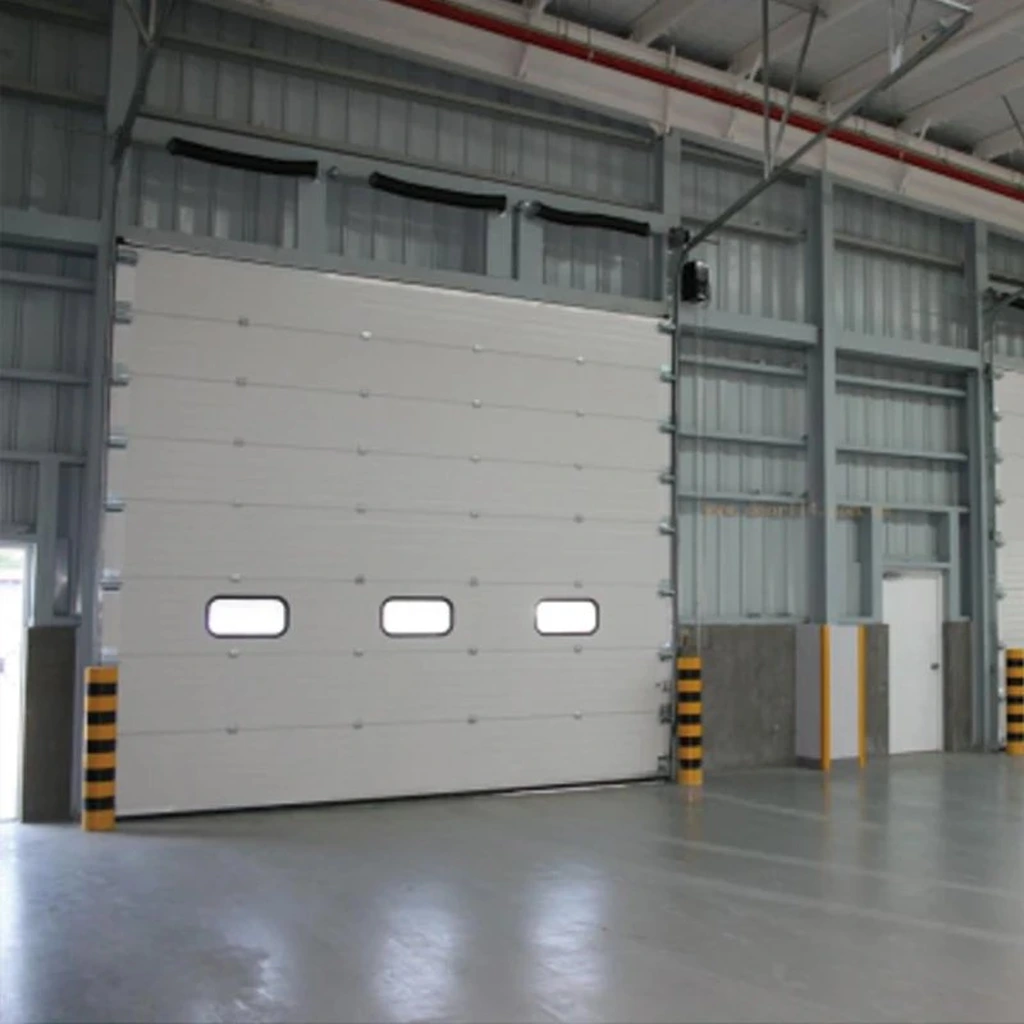
For facilities that require insulated panels, flexible opening configurations, and multiple control options, the Model 011 Industrial Sectional Overhead Door offers a configurable solution for warehouses, logistics distribution centers, manufacturing facilities, and commercial buildings.
The door uses high-density, CFC-free polyurethane (PU) insulated sandwich panels in thicknesses of 42 mm, 50 mm, and 75 mm. Its maximum stated clear opening is 9,000 mm wide by 9,000 mm high, with custom sizing available.
Insulation and Environmental Performance
Model 011 has a stated thermal transmittance of 1.0 W/(m²·K), measured on a 5,000 × 5,000 mm steel door. This provides a reference for evaluating its thermal performance in applications where controlling heat transfer is important.
Its performance ratings include Class 3 water permeability under EN 12425 and Class 3 air permeability under EN 12426 for solid-panel configurations without a wicket door. Wind load resistance under EN 12424 is rated Class 3 for widths below 4,250 mm without a wicket door, and Class 2 for widths above 4,250 mm or configurations with a wicket door.
The door has an operating noise level of no more than 55 dB(A) and an IP54 electrical enclosure rating. Its stated operating temperature range is −30°C to +75°C.
These ratings help buyers assess whether the door’s specified performance aligns with their facility’s operating conditions. The applicable rating should always be checked against the proposed size and configuration.
Drive System and Safety Features
Model 011 supports industrial gear motor options with power ratings of 500 W, 650 W, and 800 W. The appropriate drive is configured according to the door’s dimensions and weight. Available power supplies include single-phase 220 V and three-phase 380 V at 50–60 Hz.
The motorized system is complemented by a manual emergency chain hoist, allowing manual operation during a power outage without disengaging the balance system.
Standard safety devices include cable-break protection, spring-break protection, and a bottom safety edge or in-track photocells. Depending on the facility’s traffic and control requirements, activation options include wall-mounted pushbuttons, pull cord switches, RF remote controls, magnetic floor loops, photocell sensors, and microwave radar sensors.
Access, Glazing, and Color Options
For facilities that need separate personnel access, Model 011 can be configured with an optional 900 mm-wide pedestrian wicket door. The standard reinforced threshold is 180 mm high, with continuous perimeter seals and reinforced structural profiles.
Vision options include rectangular or oval acrylic windows and full-vision glazed sections with anodized aluminum frames. Depending on the selected configuration, glazing options include single or double acrylic or polycarbonate panels in clear, frosted, or tinted finishes.
The door panels use weather-resistant polyester coil coatings. Standard exterior colors include RAL 3002, RAL 5010, RAL 9006, RAL 7035, RAL 7032, and RAL 9010, while the standard interior color is RAL 9002. Custom RAL factory spray finishes are available on request.
Typical Applications
Model 011 can be configured for several types of industrial and commercial facilities:
- Logistics hubs and distribution warehouses: Insulated panels and configurable access options support loading and dispatch areas.
- Automotive dealerships and service centers: Full-vision glazing can provide additional natural light and visibility in workshop or display areas.
- Manufacturing and assembly facilities: Different opening dimensions and control methods accommodate factory perimeter doors and internal partitions.
- Cold-chain and food processing facilities: The 75 mm panel option provides an insulation configuration for applications where limiting heat transfer is important.
Conclusion
Choosing an industrial sectional overhead door involves more than comparing dimensions or panel thickness. Buyers should evaluate thermal performance, weather resistance, daily traffic, safety devices, access requirements, and installation conditions together.
For facilities that need a configurable insulated door, Model 011 offers multiple panel thicknesses, a range of motor options, optional pedestrian access, different glazing arrangements, and several automated control methods. Comparing these features with the actual requirements of the facility provides a practical basis for selecting a suitable industrial door configuration. Contact us to learn more about Model 011 and discuss the right configuration for your facility.
Frequently Asked Questions
1. What Is an Industrial Sectional Overhead Door?
An industrial sectional overhead door consists of connected panels that move upward along an overhead track. It is commonly used in warehouses, logistics centers, and manufacturing facilities.
2. How Do You Choose the Right Industrial Sectional Door?
Consider the opening dimensions, insulation requirements, weather resistance, operating methods, safety devices, and available installation space. The right configuration depends on your facility’s specific needs.
3. What Panel Thicknesses Are Available for Model 011?
Model 011 is available with 42 mm, 50 mm, and 75 mm insulated panels. The appropriate option depends on the facility’s thermal insulation requirements and operating environment.