Introduction
Industrial buyers looking for a high speed door face a familiar problem: every manufacturer claims fast opening speeds, durable curtains, and low maintenance, yet the actual engineering data needed to compare models is usually buried in PDF spec sheets or missing entirely. A procurement engineer evaluating doors for a warehouse corridor needs different performance evidence than a facility manager specifying an entrance for a food-grade cleanroom, but most product pages treat them as the same buyer.
This guide is written for the technical evaluation stage. It explains how to read EN 13241-1 performance classes, when a zipper-guided fabric door outperforms a brush-sealed roll-up, and what questions to ask before accepting a quotation. Whether you are sourcing for a distribution center, a pharmaceutical packaging line, or an OEM distributorship, the goal is the same: replace marketing claims with measurable selection criteria.
Key Takeaways
- A high speed door is an industrial access solution built for rapid cycles, environmental separation, and high-frequency traffic. Selecting the right model means matching EN 13241-1 performance classes to your specific indoor or exterior conditions—not just picking the fastest option.
- Zipper-guided systems outperform traditional brush-sealed fabric doors on seal integrity and maintenance. They automatically reinsert after impact, making them particularly effective in controlled environments where airborne contamination and drafts must be contained.
- Buyers should demand documented test results for wind load resistance (EN 12424), air permeability (EN 12426), thermal transmittance (EN 12428), and verified cycle life (EN 12604/12605) before issuing a purchase order.
- The total cost of ownership spans energy savings, maintenance intervals, spare parts availability, and OEM customization support. The lowest quoted price rarely delivers the lowest lifetime cost.
What Is a High Speed Door?
How High Speed Doors Differ from Traditional Industrial Doors
In North America, DASMA defines a high-performance door as a non-residential powered door with either a minimum of 100 operating cycles per day or an opening speed of at least 508 mm/s. In Europe, the threshold is generally understood as greater than 500 mm/s. These definitions matter because they separate true industrial-grade systems from standard roller shutters that happen to have a faster motor.
The engineering differences run deeper than speed. A genuine high speed door uses a strengthened drivetrain, a lightweight PVC or fabric curtain, and a motor rated for continuous high-cycle operation. Traditional roll-up doors are built for intermittent use. Their seals degrade faster, their motors overheat under repeated cycling, and the gaps around the curtain allow significant air infiltration. Over a year of heavy logistics traffic, that infiltration translates into measurable HVAC losses and higher particle counts in controlled zones.
Core Applications: Warehousing, Food Processing, Cleanrooms, and Cold Storage
The value of a high speed door depends entirely on where it is installed.
In warehousing and distribution, the priority is traffic flow. Forklifts and AGVs moving between storage and dispatch cannot afford to queue at a slow opening. Food industry doors face a different challenge: maintaining hygiene separation between raw processing and packaging areas while allowing rapid passage. Every second the door stays open increases the risk of airborne contamination and temperature drift.
Cleanrooms depend on stable air pressure and particulate control. A slow door destroys the pressure cascade the moment it opens. Cold storage facilities face a similar problem in reverse: warm air rushes in, ice builds up on evaporators, and energy bills climb. In each case, the door is not an afterthought. It is an operational control device.
Types of High Speed Doors and Where Each Fits
PVC Fabric Roll-Up Doors (Standard Indoor Logistics)
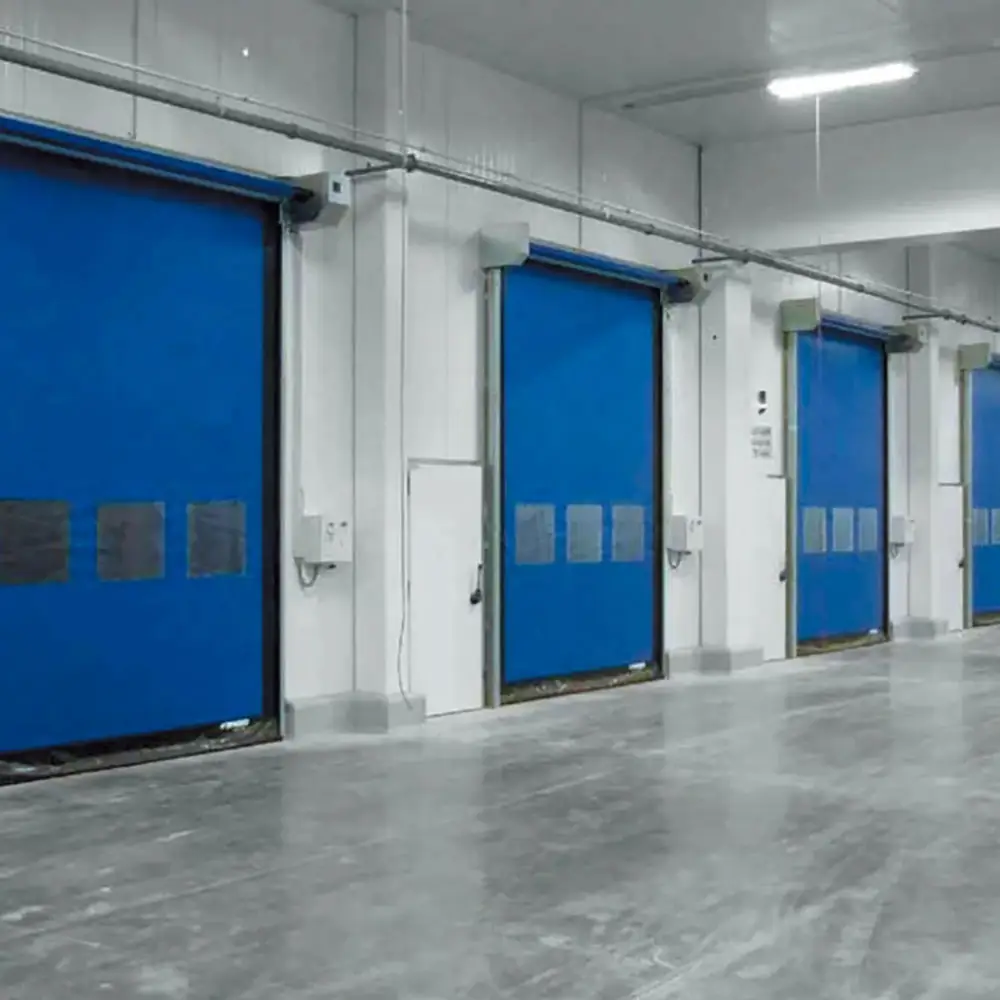
High speed fabric doors are the baseline for general indoor logistics. They consist of a flexible PVC curtain that rolls up around a barrel, driven by an industrial motor. Their strengths are straightforward: fast cycling, compact overhead footprint, and lower upfront cost compared to rigid systems.
The limitations are equally clear. Most fabric roll-up doors rely on brush or blade seals along the side guides. These seals wear down, compress over time, and allow increasing air leakage. Wind resistance is modest, typically rated for indoor corridors where external wind pressure is not a factor. For dry warehouses and general production areas with moderate traffic, they are a practical choice. For environments demanding tight environmental containment, they fall short.
Zipper High Speed Doors (Cleanrooms, Self-Repairing Indoor Passages)
Zipper doors replace the brush seal with a continuous zipper-guided track system. The curtain edges lock into the side guides through a sealed channel, creating a perimeter seal that brush systems cannot match. If a forklift or pallet accidentally dislodges the curtain, the zipper mechanism reinserts it automatically during the next opening cycle. This eliminates manual resetting and unplanned downtime.
The Model 012 Compact High-Speed Zipper Door is built specifically for high-frequency indoor passageways. It opens at up to 2.0 m/s and closes at 1.2 m/s. The curtain is an elastic soft material with zero rigid weights, which removes the safety hazard posed by metal bottom bars or stiffeners. It also means the door can absorb incidental contact without damaging the curtain or the traffic passing through.
These characteristics make self repairing high speed doors a better fit than standard fabric models for corridors connecting production and storage, internal partitioning in manufacturing workshops, and secondary doorways in food and pharmaceutical packaging areas. They also function effectively as cleanroom doors where maintaining air pressure separation and reducing particle transfer are daily priorities.
Rigid Spiral High Speed Doors (Exterior, High Wind Load, Security)
Rigid spiral doors use aluminum or steel panels that coil into a spiral mechanism rather than rolling around a drum. This construction delivers wind load resistance up to Class 5 (greater than 1,000 N/m²) and provides better thermal insulation and security than fabric systems.
The trade-off is cost and size. Rigid spiral units typically start around $3,990 and can exceed $4,890 depending on dimensions and insulation. Their structural footprint is larger, and their mass requires heavier mounting hardware. Installing a rigid spiral door in an indoor corridor where wind load is negligible wastes budget and headroom.
Insulated Cold Storage Doors (Temperature-Controlled Environments)
Cold storage doors prioritize thermal retention over raw speed. Their U-values can reach as low as 0.57 W/m²K, compared to approximately 6.02 W/m²K for a standard fabric curtain. Heated guide rails and anti-condensation controls prevent ice buildup that would jam a standard high speed door within days.
Opening speeds are typically lower—up to 1.5 m/s—because the insulated panels are heavier and because the energy penalty of a slower cycle is outweighed by the thermal savings during the closed state.
How to Evaluate High Speed Door Technical Performance
Understanding EN 13241-1 Performance Classes
EN 13241-1 is the overarching European standard for industrial door safety and performance. A CE mark alone means little if the manufacturer cannot produce test reports showing the specific performance class achieved for each relevant characteristic.
Wind Load Resistance (EN 12424)
- Class 1 (~300 N/m²): Suitable for indoor corridors, cleanrooms, and food processing areas. The Model 012 is rated Class 1 for indoor use only, tested at 3,500 mm × 3,500 mm.
- Class 3–4 (~700–1,000 N/m²): Required for exterior openings with moderate wind exposure.
- Class 5 (>1,000 N/m²): Necessary for high wind zones, coastal sites, or exposed industrial yards.
Air Permeability (EN 12426)
- Class 1: 24 m³/m²/h at 50 Pa. Sufficient for indoor environmental separation between production zones.
- Class 3: Tighter sealing for temperature-controlled or pressure-controlled spaces.
Water Permeability (EN 12425)
- Class 1: Minimal resistance. Acceptable for fully indoor installations.
- Class 2–3: Required for exterior entrances or facilities with regular wash-down protocols.
Thermal Transmittance / U-Value (EN 12428)
- Standard high speed fabric doors: ~6.02 W/m²K. The Model 012 achieves this figure. It is designed for speed and cycling efficiency, not thermal insulation.
- Insulated rigid doors: 0.57–1.95 W/m²K. The right choice when temperature retention matters more than opening velocity.
Technical Performance Comparison
| Performance Characteristic | Test Standard | Model 012 (Zipper/Fabric) | Rigid Spiral Door | Cold Storage Door |
| Wind Load Resistance | EN 12424 | Class 1 (Indoor only) | Class 3–5 | Class 2–4 |
| Air Permeability | EN 12426 | Class 1 | Class 1–3 | Class 1–2 |
| Water Permeability | EN 12425 | Class 1 | Class 2–3 | Class 2–3 |
| Thermal Transmittance (U-Value) | EN 12428 | 6.02 W/m²K | 1.4–2.5 W/m²K | 0.57–1.95 W/m²K |
| Durability (Cycles) | EN 12604/12605 | 1,000,000 | 750,000–1,000,000 | 500,000–750,000 |
| Max Opening Speed | — | Up to 2.0 m/s | Up to 2.5 m/s | Up to 1.5 m/s |
| Self-Repairing Capability | — | Yes (zipper reinsertion) | No (rigid panels) | No |
Use this table to narrow your shortlist before contacting suppliers. If your opening is an interior corridor with forklift traffic and no wind exposure, a Class 1 zipper door with self-repair capability is the logical starting point. If the opening faces a loading yard in a coastal region, a rigid spiral door rated Class 4 or 5 is non-negotiable.
Operating Speed vs. Application Requirements
Standard fabric doors open at 0.6–1.5 m/s. High-performance models reach 2.0–2.5 m/s. Beyond 2.0 m/s, the engineering complexity increases: safety system reaction times shrink, motor torque requirements rise, and the control system must manage deceleration precisely to avoid curtain whip or mechanical stress.
For most indoor logistics corridors, 1.5–2.0 m/s is the practical sweet spot. It reduces transit time without pushing the mechanical system into a durability-reducing regime. The Model 012’s 2.0 m/s opening speed sits at the upper end of this practical range.
Durability and Cycle Life (EN 12604/12605)
A rating of 1,000,000 cycles means little without context. At 250 cycles per day, five days per week, that lifespan exceeds ten years. The Model 012 has been tested and passed the EN 12604/12605 durability standard at this level. When evaluating competing claims, ask for the test report number and the accredited body that witnessed the testing.
High Speed Door Safety Systems and Control Integration
Standard Safety Devices: Photocells, Safety Edges, and Light Curtains
In-track photoelectric sensors are the baseline for forklift corridors. They monitor the doorway while the curtain is moving and halt or reverse motion if the beam is interrupted. The Model 012 includes door-track photoelectric protection as standard.
A wireless soft-bottom safety edge detects physical contact along the full width of the curtain and triggers an immediate upward reversal. This is essential in mixed-traffic zones where pedestrians and forklifts share the same opening.
Light curtains provide non-contact detection up to 2.5 m in height. They are the premium option for high-risk crossings or installations where even momentary contact is unacceptable.
Activation Options: Radar, Loop Detectors, Pull-Cords, and AGV Integration
Radar sensors offer hands-free activation for forklift operators. Induction loops are reliable in dusty environments where optical sensors might fail, though they require cutting into the floor. Pull-cord switches work for intermittent manual control.
If you are running AGVs or automated conveyors, the activation method must be specified during quotation. The control system needs a compatible communication interface—whether that is a dry contact, PLC signal, or fieldbus protocol. Retrofitting AGV compatibility after installation is expensive and often impractical.
Motor and Control Box Specifications
The Model 012 uses a 1500W motor with an integrated Variable Frequency Drive (VFD). Soft start and soft stop functions reduce mechanical stress on the drivetrain and extend service life. The motor and wall-mounted control unit both carry an IP55 enclosure rating, which protects against dust ingress and low-pressure water jets. For wash-down environments or high-humidity areas, IP65 should be specified.
The control box includes Open, Close, and Stop pushbuttons, a master power switch, and expandable interfaces for interlocking with adjacent doors or building management systems. Frame material is galvanized steel as standard, with stainless steel available for corrosive or food-grade installations.
How to Choose a Reliable High Speed Door Manufacturer
Evaluating Factory Capability and Quality Control
Start with factory experience and production equipment. A manufacturer with 90-plus machines and two decades of production history has likely already solved the integration problems that plague newer entrants. Ask whether quality management is certified to ISO 9001.
Testing capability matters. Some manufacturers validate EN 13241-1 performance in-house. Others use accredited third-party laboratories. Both approaches work, but the documentation should be current, model-specific, and available on request.
Required Certifications by Target Market
- CE marking plus EN 13241-1: Mandatory for European market access.
- IEC 60601-1: Electrical safety standard for medical and pharmaceutical environments.
- FDA compliance: Required for food and pharmaceutical facilities in the United States.
- ISO 13485: Quality management system certification essential for medical device and pharmaceutical supply chains.
Never assume that a CE mark covers all of the above. Each certification addresses a different risk profile and regulatory jurisdiction.
OEM/ODM Customization and After-Sales Support
Feasible customization typically includes logo placement, housing color in standard RAL finishes, software interface language, pre-programmed treatment parameters, and retail packaging. These changes usually do not require new tooling.
Unique frame extrusions, proprietary control protocols, or non-standard curtain materials do require tooling investment. A reliable manufacturer will tell you upfront which requests fall into each category rather than quoting low and billing engineering changes later.
After-sales support should include spare parts availability with defined lead times, remote technical support for control system diagnostics, and operator training documentation in your local language. If a manufacturer cannot guarantee spare parts availability for at least ten years, the low initial quote carries hidden replacement risk.
Frequently Asked Questions
What is the difference between a zipper high speed door and a standard fabric roll-up door?
Zipper doors use a continuous zipper track that auto-locks the curtain into side guides, delivering a far tighter seal than brush seals that wear down over time. After impact dislodgement, the zipper self-reinserts on the next cycle, reducing maintenance—ideal for cleanrooms and food processing.
What does EN 13241-1 Class 1 wind load mean for a high speed door?
Class 1 means wind resistance of approx. 300 N/m² (~30 m/s). Indoor corridors only—not for exterior loading bays or exposed openings. Exterior use requires Class 3 (700 N/m²) or higher.
How much energy can a high speed door actually save?
Depends on opening size, cycle frequency, temperature delta, and HVAC load. Climate-controlled facilities typically save 15–30% on heating/cooling costs.
Can a high speed door be integrated with AGV and automated conveyor systems?
Yes. Common methods include radar activation, induction loop triggers, and PLC interlocking. AGV compatibility must be specified at quotation—retrofitting is costly and may require control unit replacement.
Conclusion
Selecting the right high speed door starts with the application context, not the product brochure. Indoor logistics corridors demand different performance characteristics than exterior loading bays or freezer rooms. Match the EN 13241-1 performance class to the real operating environment. Verify that the cycle life, safety systems, and control interfaces align with your traffic patterns and automation roadmap.
For facilities managing high-frequency indoor passageways—whether in manufacturing, food packaging, pharmaceutical packaging, or logistics warehousing—zipper-guided systems offer a specific advantage. The self-reinserting track, tight perimeter seal, and impact-absorbing soft curtain address the daily operational problems that standard fabric doors simply cannot solve.
Share your doorway dimensions, traffic pattern and environment (indoor / exterior, temperature control, hygiene class). Our engineering team will return a project-specific quotation along with the EN 13241-1 and EN 12604/12605 test documentation for Model 012 — plus the OEM/ODM customization options available for your market.