Introduction
Industrial fabric doors are designed for access points where conventional rigid doors may be difficult to accommodate. They use flexible curtains supported by reinforced structural components, making them suitable for large openings in manufacturing plants, aircraft hangars, shipyards, and heavy-vehicle maintenance facilities.
These installations present several engineering challenges. Large door leaves must withstand wind pressure while operating reliably in environments affected by extreme temperatures, dust, moisture, and frequent vehicle movement. Limited headroom or side clearance can also restrict the available installation space.
To address these challenges, heavy-duty industrial fabric doors combine reinforced double-layer curtains, horizontal aluminum intermediate beams, heavy-duty side guides, mechanical safety arrestors, and application-specific materials. These features make high performance doors suitable for large industrial openings where structural stability, environmental resistance, and reliable operation are essential.
This guide examines the structural design, environmental performance, safety features, and procurement considerations that determine whether a heavy-duty fabric door is appropriate for a particular industrial facility.
Key Takeaways
- Large-opening capability: The Model 016 Heavy-Duty Vertical Lifting Fabric Door supports custom dimensions up to 16,000 mm wide × 12,000 mm high, subject to project requirements.
- Wind-load resistance: Reinforced fabric and horizontal aluminum beams help distribute wind loads to the side guides. Published resistance ranges from 0.7 to 1.6 kPa, depending on configuration.
- Environmental adaptability: The standard operating temperature range is −35°C to +70°C, with an optional Arctic curtain rated for temperatures down to −45°C.
- Integrated safety: Four-hook mechanical safety arrestors, an optical safety edge, and emergency-stop controls support safe operation.
- Project-specific selection: Curtain materials, mounting arrangements, sealing, and drive systems should match the opening dimensions, environmental exposure, and operating requirements.
How Do Industrial Fabric Doors Accommodate Large Openings?
Reinforced Double-Layer Fabric and Intermediate Beams
Large openings require a door curtain that can move vertically without relying on fabric flexibility alone for structural stability. The Model 016 Heavy-Duty Vertical Lifting Fabric Door addresses this requirement through a reinforced curtain assembly.
Its main components include:
- Double-layer fabric: Two layers of 1100 dtex vinyl-coated polyester provide the flexible curtain structure.
- Horizontal aluminum intermediate beams: These beams reinforce the curtain and help transfer wind loads toward the supporting guide rails.
- Internal air pocket: The space between the fabric layers provides a thermal buffer between adjacent areas.
- Heavy-duty vertical aluminum guide rails: The side guides support curtain movement and transfer structural loads to the building interface.
Unlike a single-layer curtain, this reinforced assembly combines flexible fabric with horizontal beams and vertical guide rails to support the curtain and transfer loads. Its suitability depends on the opening dimensions, reinforcement layout, fabric specification, and supporting structure.
Large Dimensions and Space-Efficient Vertical Lifting
The Model 016 uses an electric gear motor hoist to raise the curtain vertically. As the door opens, the curtain folds into a compact stack beneath the header casing, keeping the main opening clear.
This arrangement can be useful where large industrial access points must accommodate trucks, heavy equipment, aircraft, or other oversized loads. Vertical lifting can also reduce the need for side clearance associated with some horizontally moving door systems.
Key specifications include:
| Parameter | Model 016 specification |
| Maximum dimensions | 16,000 mm W × 12,000 mm H |
| Door leaf thickness | 160 mm |
| Opening and closing speed | 0.2–0.3 m/s |
| Lifting arrangement | Electric gear motor hoist |
| Drive configuration for heights above 15 m | Dual synchronized motors |
The maximum dimensions are a reference for project planning, not confirmation that every building can accommodate the door. Structural support, opening geometry, wind exposure, header clearance, and available mounting space must be assessed before a configuration is finalized.
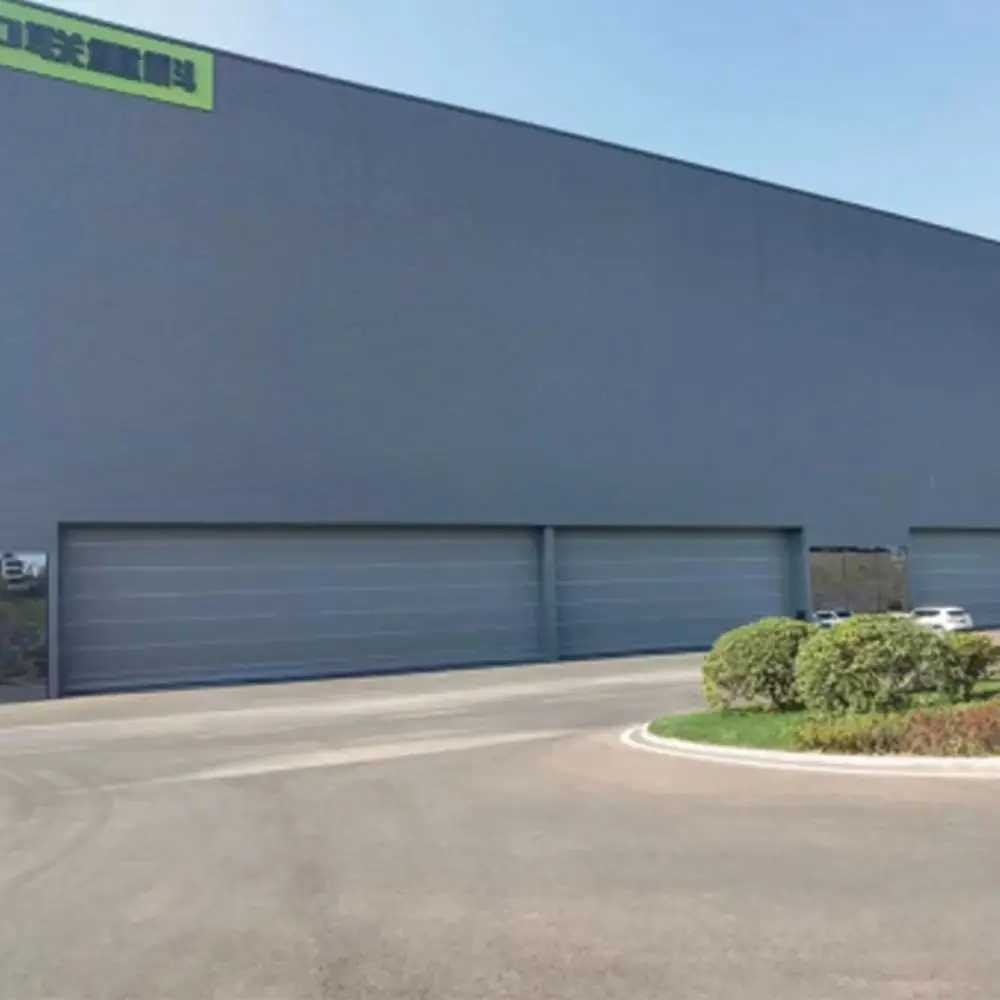
Mounting Options for Different Building Structures
Three mounting arrangements can address different installation constraints.
- Interior wall mounting: Places the drive components and guide rails inside the building, helping reduce direct exposure to outdoor conditions.
- In-jamb mounting: Positions the guides within the opening and may suit locations with limited side room. Where vehicles operate nearby, guide-rail protection should be considered.
- Exterior wall mounting: Can be appropriate when indoor overhead space is restricted or internal environmental conditions make exterior installation preferable.
The final arrangement should reflect the building structure, equipment access, exposure conditions, and available installation clearance. A site survey is necessary to confirm whether the selected mounting method is practical.
How Do Industrial Fabric Doors Resist Wind, Dust, Moisture, and Temperature Extremes?
Wind-Load Resistance and Structural Stability
Wind pressure is a major consideration for large industrial openings. The larger the door leaf, the more important it becomes to assess how the curtain, reinforcement, guide rails, and bottom profile work together.
On the Model 016, horizontal aluminum beams reinforce the curtain, while heavy-duty side guides provide structural support. The bottom steel profile contributes to the stability of the lower curtain section. Together, these components help manage positive and negative wind pressure.
Performance specifications include:
| Performance characteristic | Model 016 specification |
| Wind-load resistance | 0.7–1.6 kPa, Classes 3–5 per EN 12424 |
| Operational wind speed | Up to 20 m/s |
| Air leakage | 12 m³/(m²·h), Class 2 reference |
| Water permeability | Class 3 |
| Acoustic reduction | 15 dB Rw |
These figures describe different aspects of performance and should not be treated as interchangeable.
Wind-load resistance, expressed in kilopascals, describes pressure loading on the door assembly. Operational wind speed refers to the stated wind conditions associated with operation. The two measures are not equivalent, and the operational limit should be confirmed against the manufacturer’s applicable documentation.
The published wind-load rating also varies with door dimensions and configuration. A project exposed to stronger winds, unusual pressure patterns, or demanding building conditions requires an engineering review to confirm that the selected assembly is suitable.
Protection Against Dust, Moisture, and Air Leakage
Perimeter sealing helps reduce the gaps through which air, moisture, and airborne particles can pass.
The Model 016 uses several sealing elements:
- Bottom rubber seals help close the gap between the curtain and the floor.
- Side-guide seals reduce gaps along the vertical edges.
- A top header seal contributes to closure around the upper section.
- The double-layer curtain provides an additional barrier between adjacent spaces.
These features can help control environmental exchange between work areas, particularly where dust migration or temperature differences affect operations.
However, a sealed perimeter does not make a door completely airtight or dustproof. Actual performance depends on installation accuracy, floor flatness, pressure differences, curtain condition, and the complete door assembly. Facilities requiring strict contamination control should establish measurable acceptance criteria and verify that the proposed configuration meets them.
Water permeability and air leakage ratings should also be evaluated against the site’s exposure. Where moisture control is important, the building interface and drainage arrangements may affect the result as much as the curtain itself.
Operating in Extreme Temperatures and Specialized Environments
The standard operating temperature range for the Model 016 is −35°C to +70°C. An optional Arctic curtain extends the stated lower operating limit to −45°C.
Specialized curtain materials can address other environmental requirements:
- Arctic curtain: Intended for selected sub-zero environments and cold-storage applications.
- Heat-resistant or chemical-resistant curtain: Available for certain applications involving radiant heat, welding slag, or corrosive substances.
- Acoustic curtain: Intended to provide additional noise attenuation in industrial facilities.
- Security curtain: Incorporates internal galvanized steel wire mesh to improve resistance to cutting and intrusion.
Material selection should be based on the actual exposure rather than broad environmental labels. For example, a curtain suitable for moderate radiant heat may not withstand direct contact with molten material. Similarly, chemical resistance depends on the specific substance, concentration, temperature, and duration of exposure.
Before specifying a specialized curtain, confirm its documented compatibility and operating limits with the manufacturer. The complete assembly, including seals and other components, must also be suitable for the intended environment.
Which Safety and Operating Features Matter in Harsh Industrial Conditions?
Four-Hook Mechanical Safety Arrestors
Large vertically lifted curtains require safeguards against uncontrolled movement and certain mechanical failures. The Model 016 uses a four-hook mechanical safety system with two functions.
The upper hooks act as wind locks when the door is closed, helping restrain the curtain under wind loading. The lower hooks serve as anti-drop arrestors if a lifting belt becomes slack or breaks.
These functions are particularly relevant to large door leaves, where uncontrolled movement could create significant risks to personnel, vehicles, and equipment.
Mechanical arrestors do not eliminate every possible failure. Their effectiveness depends on correct installation, suitable adjustment, inspection, and maintenance. They should form part of a complete safety assessment rather than replace it.
Optical Safety Edge and Emergency Controls
An integrated optical safety edge detects contact with an obstruction and triggers movement reversal. An emergency-stop pushbutton station provides a separate means of stopping the door when an unsafe condition occurs.
The appropriate sensor arrangement depends on how people, forklifts, trucks, and other equipment move through the opening. Control logic should reflect these traffic patterns and the applicable local safety requirements.
Where automatic activation is required, the design should also address the risks of unintended movement and confirm that the installed safeguards operate as intended.
Drive Reliability and Maintenance Planning
The electric hoisting system raises the curtain at the specified operating speed. For door heights exceeding 15 m, the documented drive arrangement uses dual synchronized motors. Correct synchronization is important to maintain coordinated lifting.
A practical maintenance plan should cover:
- Inspecting the fabric, seams, guide rails, seals, lifting components, and safety devices.
- Verifying motor synchronization and control-system operation where applicable.
- Confirming spare-parts availability and service arrangements.
- Recording operating cycles, faults, impacts, and downtime.
Inspection frequency should reflect operating intensity, environmental exposure, manufacturer instructions, and applicable regulations. Specific maintenance intervals and expected service life should not be assumed without supporting documentation.
How Should Buyers Compare Industrial Fabric Door Specifications and Costs?
Compare the Specifications That Affect Project Suitability
When comparing large industrial doors, procurement teams should assess the complete assembly rather than relying on nominal dimensions or general product descriptions.
The following framework helps identify the information needed before a technical and commercial decision.
| Selection criterion | Key Considerations | Key Benefits |
| Opening dimensions | Clear width, height, and installation clearance | Confirms physical fit |
| Wind resistance | Rated pressure, test evidence, and supported dimensions | Establishes structural suitability |
| Curtain construction | Fabric layers, reinforcement, and specialized coatings | Determines environmental compatibility |
| Operating conditions | Temperature, dust, moisture, and chemical exposure | Helps prevent material failure |
| Safety system | Anti-drop devices, sensors, emergency stop, and controls | Supports risk management |
| Drive and controls | Motor configuration, power supply, and integration | Confirms operational compatibility |
| Installation and service | Mounting method, commissioning, warranty, and parts | Helps manage project and lifecycle costs |
Any specification that is unavailable should be marked as “not published” until the manufacturer confirms it. This avoids treating missing information as evidence that a requirement has been met.
Evaluate Total Installed Cost Instead of Purchase Price Alone
The purchase price is only one component of the total project cost. Depending on the installation, the overall budget may include:
- The door assembly, specialized curtains, controls, and safety equipment.
- Shipping, lifting arrangements, installation labor, and electrical work.
- Structural modifications, commissioning, and acceptance testing.
- Preventive maintenance, replacement components, warranty exclusions, and service labor.
Compare quotations against equivalent technical specifications and installation requirements. Each quotation should identify included and excluded items, installation work, commissioning, warranty coverage, maintenance provisions, and any assumptions affecting the final price.
Where Are Heavy-Duty Industrial Fabric Doors Most Suitable?
Heavy Manufacturing, Mining, and Metal Processing
Steel mills, foundries, fabrication plants, mining facilities, and heavy-vehicle maintenance bays may require large access openings and curtains designed for demanding working conditions. Reinforced construction can support structural performance, while specialized materials may address selected heat or chemical exposures.
The material and wind-load configuration must be matched to the facility’s actual operating conditions.
Aviation, Shipbuilding, and Large Maintenance Facilities
Aircraft hangars, shipyards, and dry docks often require oversized openings for equipment, vehicles, or large structures. Vertical lifting can keep the opening clear, while the reinforced curtain assembly can help address outdoor wind exposure.
Building geometry, mounting arrangements, and local wind conditions remain important selection factors.
Waste Treatment and High-Dust Industrial Facilities
Waste processing, composting, and bulk-material handling facilities may benefit from perimeter seals that reduce unwanted air exchange and particle movement. Curtain materials should be selected according to the substances, moisture levels, and cleaning methods encountered on site.
No single industrial door solutions configuration is suitable for every application. The appropriate design depends on opening dimensions, wind exposure, temperature, contamination risks, traffic patterns, and safety requirements.
Model 016 Heavy-Duty Vertical Lifting Fabric Door
The Model 016 is designed for industrial access points that require a reinforced flexible curtain and vertical lifting arrangement. Its main features include:
- Reinforced curtain assembly: Double-layer 1100 dtex PVC-coated polyester fabric with horizontal aluminum intermediate beams.
- Configurable environmental performance: Wind-load resistance and operating temperature options vary according to the selected configuration and project requirements.
- Integrated safety and lifting systems: Four-hook mechanical safety arrestors, an optical safety edge, and a vertical lifting drive.
For facilities exposed to strong winds, wind resistant doors should be selected using documented pressure ratings and applicable configuration details. A technical review can establish the required dimensions, curtain materials, mounting arrangement, control interfaces, and installation provisions.
The Model 016 may be suitable when its documented capabilities align with the project’s requirements.
Frequently Asked Questions
What size openings can industrial fabric doors accommodate?
The Model 016 Heavy-Duty Vertical Lifting Fabric Door supports custom dimensions up to 16,000 mm wide × 12,000 mm high. Actual suitability depends on the structural opening, wind-load requirements, mounting configuration, available clearance, and project-specific engineering assessment.
How much wind pressure can a heavy-duty industrial fabric door withstand?
Model 016 lists wind-load resistance from 0.7 to 1.6 kPa, corresponding to Classes 3–5 under EN 12424. The applicable rating depends on the door’s dimensions and configuration. The required performance should be checked against the project’s structural design and supporting manufacturer documentation.
Can industrial fabric doors operate in extremely cold or hot environments?
Model 016 specifies a standard operating temperature range of −35°C to +70°C. An optional Arctic curtain extends the stated lower limit to −45°C. Specialized heat-resistant or chemical-resistant materials may be available for selected applications, subject to verified operating limits and material compatibility.
What safety features should a large industrial fabric door include?
Relevant features may include mechanical anti-drop arrestors, wind locks, an optical safety edge, emergency-stop controls, and suitable activation sensors. The final configuration should reflect the installation’s risk assessment, traffic patterns, operating environment, and applicable safety requirements.
Conclusion
Industrial fabric doors provide a practical option for oversized industrial access points where structural reinforcement, environmental resistance, and safe vertical lifting are important. Selecting the right configuration requires matching documented performance with the facility’s operating conditions and installation requirements.
Request a quote for the Model 016 Heavy-Duty Vertical Lifting Fabric Door. Provide the opening dimensions, environmental conditions, wind-load requirements, and preferred mounting arrangement for a project-specific technical assessment.